
Introduction
Achieving TDN 5 (the highest level) in the TestDaF writing section requires more than just good German skills—it demands strategic thinking and precise execution. This level represents near-native proficiency, where candidates must demonstrate sophisticated argumentation, complex sentence structures, and flawless academic register.
In this article, you'll discover three proven strategies that distinguish TDN 5 candidates from the rest, plus common pitfalls that prevent even advanced learners from reaching the top score.
Why This Matters
The TestDaF writing section carries enormous weight for university admission in Germany. While TDN 4 meets minimum requirements, TDN 5 opens doors to competitive programs and demonstrates the academic writing proficiency needed for thesis work and research publications. Universities increasingly favor candidates with TDN 5 writing scores, especially in humanities and social sciences where written communication is paramount.
More importantly, the skills required for TDN 5 writing—nuanced argumentation, precise vocabulary, and complex syntax—directly translate to success in German academic environments where critical analysis and sophisticated expression are daily requirements.
Key Strategies
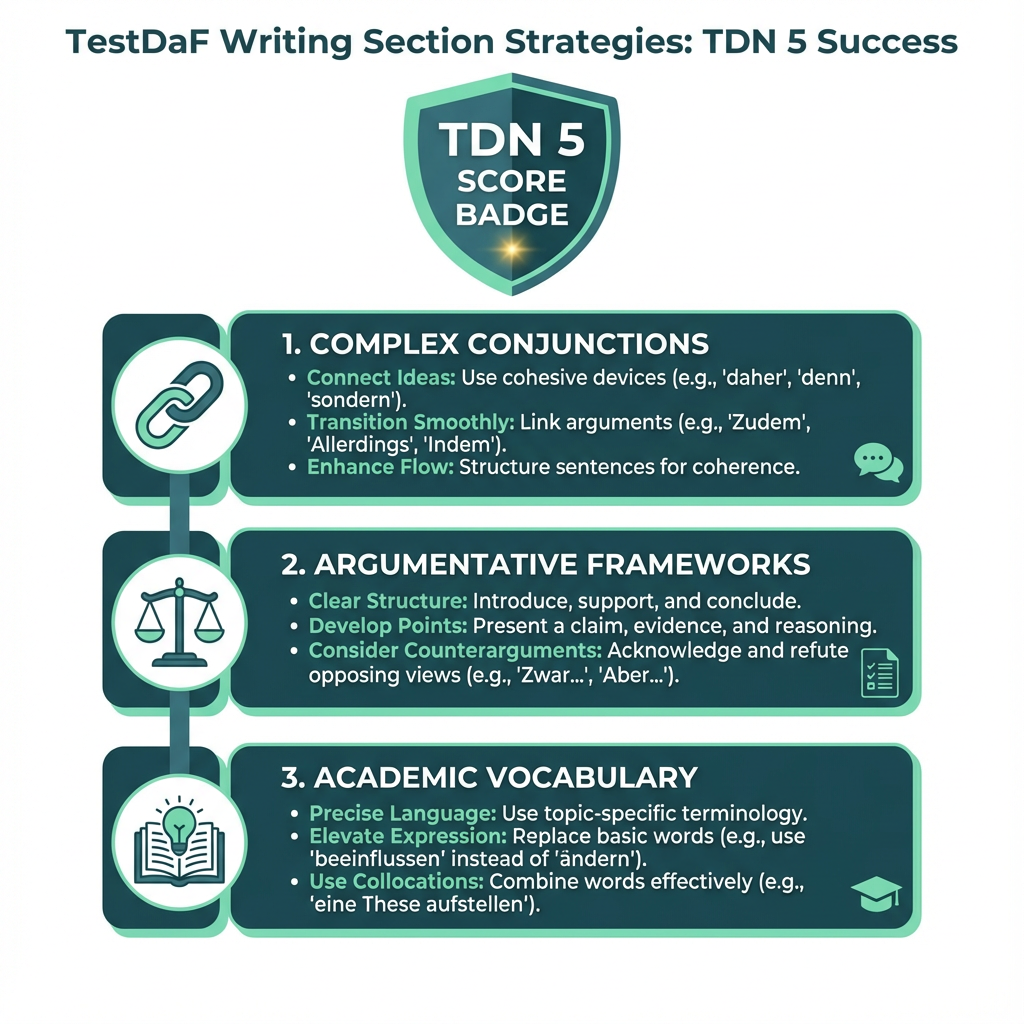
Strategy 1: Master Complex Conjunctional Structures
TDN 5 writing demands sophisticated sentence connections that go beyond basic "weil" and "dass" constructions. Use advanced conjunctions and participial constructions to create flowing, academic prose:
"In view of increasing digitalization, the question of data protection proves all the more explosive, especially since the legal framework has not yet been fully developed."
Strategy 2: Employ Sophisticated Argumentative Frameworks
Structure arguments using advanced discourse markers and metalinguistic expressions that signal high-level academic thinking. Move beyond simple pro/con structures to nuanced positioning:
"While proponents of this thesis certainly raise legitimate objections, it nevertheless cannot be dismissed that..."
Strategy 3: Integrate Precise Academic Vocabulary
Demonstrate lexical sophistication through domain-specific terminology and varied expression. Avoid repetition by using synonymous academic phrases and precise technical vocabulary:
"The empirical findings suggest that the postulated correlation cannot be confirmed without reservation."
 Infographic: The 3 Key Strategies for TDN 5 in TestDaF Writing
Common Mistakes
-
Mistake: Using repetitive sentence structures throughout the essay. Fix: Vary between main clauses, subordinate clauses, and participial constructions within each paragraph.
-
Mistake: Relying on basic vocabulary like "good/bad" or "important." Fix: Build a repertoire of academic synonyms: "conducive/hindering," "of central significance."
-
Mistake: Writing overly long sentences that become grammatically unstable. Fix: Practice complex but controlled sentence length—aim for 15-25 words with clear grammatical relationships.
-
Mistake: Failing to address counterarguments or presenting one-sided analysis. Fix: Always acknowledge opposing viewpoints before strengthening your position.
Quick Practice
Transform this basic sentence into TDN 5 level: "Students often use social media. That can be bad for their studies." Create a complex sentence using advanced conjunctions, academic vocabulary, and nuanced positioning. Hint: Consider using "to what extent," "prove problematic," and a concessive structure.
Next Steps
Start implementing these strategies immediately in your practice essays. Focus on one strategy per practice session until it becomes automatic, then combine all three. Remember that TDN 5 writing reflects not just language proficiency but academic maturity—read German academic texts daily to internalize these sophisticated patterns naturally.